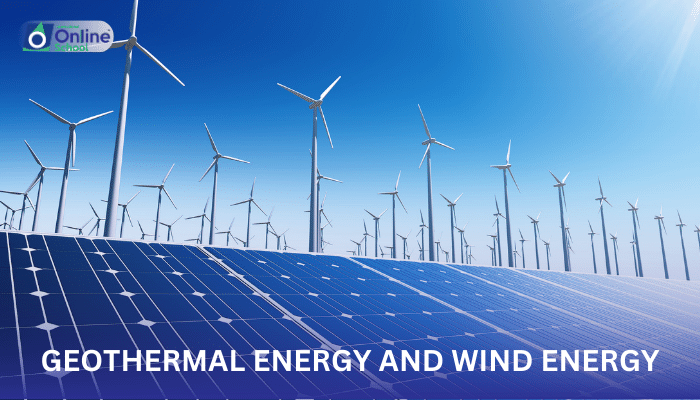
Lesson 09: Geothermal Energy and Wind Energy

Lesson 69/119 | Study Time: 30 Min
Course: Physics IX
Lesson 09: Geothermal Energy and Wind Energy

Learning Outcomes:


i. Students will grasp the concept of geothermal energy as a renewable energy source, recognizing the utilization of heat generated from the Earth's interior.


ii. Explain the process of geothermal energy extraction, including the use of geothermal wells and power plants to generate electricity or provide thermal energy.


iii. Recognize the advantages and limitations of geothermal energy, appreciating its potential as a clean and sustainable energy source.


iv. Explore the principles behind wind energy, understanding the conversion of wind's kinetic energy into mechanical energy and then into electrical energy using wind turbines.


v. Identify the factors affecting wind energy production, including wind speed, blade size, and turbine efficiency.


vi. Appreciate the significance of geothermal and wind energy as renewable energy sources, recognizing their potential to reduce reliance on fossil fuels and minimize environmental impact.


vii. Demonstrate an understanding of the environmental considerations associated with geothermal and wind energy projects.


Introduction:


As we seek sustainable energy solutions to power our world, we turn to the Earth's hidden reserves of heat and the ever-flowing currents of wind. Geothermal energy, harnessed from the Earth's molten interior, and wind energy, captured from the moving air masses, offer promising alternatives to traditional fossil fuels. This lesson delves into the realm of geothermal and wind energy, exploring their mechanisms and potential as renewable energy sources.


i. Geothermal Energy: Tapping the Earth's Inner Furnace


Geothermal energy is the heat generated from the Earth's interior, a consequence of radioactive decay and natural processes within the Earth's core. This heat can be extracted and utilized for various purposes, including electricity generation, heating, and industrial applications.


In geothermal power plants, geothermal wells are drilled deep into the Earth to access the hot water or steam reservoirs. The hot fluids are then brought to the surface, where their heat is used to generate electricity or directly provide thermal energy for heating and industrial processes.


ii. Advantages and Limitations: A Balancing Act


Geothermal energy offers several advantages over traditional energy sources:


Sustainability: Geothermal energy is a renewable resource, as the Earth's heat constantly replenishes itself.


Environmentally Friendly: Geothermal power plants produce minimal greenhouse gas emissions, making them a cleaner energy source compared to fossil fuels.


Reliable and Consistent: Geothermal energy production is not dependent on weather conditions, unlike solar and wind energy.


However, geothermal energy also faces some limitations:


Geographical Availability: Geothermal resources are concentrated in specific regions, limiting their widespread implementation.


Initial Investment Costs: Geothermal power plants require significant upfront investment costs for exploration, drilling, and infrastructure development.


Environmental Considerations: Geothermal energy extraction can potentially lead to water pollution and local seismic disturbances.


iii. Wind Energy: Capturing the Power of Wind


Wind energy harnesses the kinetic energy of wind, converting it into mechanical energy and then into electrical energy using wind turbines. Wind turbines are large, rotating structures with blades that capture wind energy and drive a generator, producing electricity.


The amount of wind energy generated depends on several factors, including wind speed, blade size, and turbine efficiency. Larger blades and higher wind speeds generally lead to higher energy production.


iv. Significance and Considerations


Geothermal and wind energy offer significant benefits as renewable energy sources:


Reduced Reliance on Fossil Fuels: Geothermal and wind energy can reduce our dependence on fossil fuels, thereby mitigating climate change and air pollution.


Sustainable Energy Sources: Both geothermal and wind energy are renewable, ensuring a continuous supply of clean energy.


Economic Benefits: Geothermal and wind energy projects can create jobs and boost local economies.


However, there are also environmental considerations associated with these energy sources:


Impact on Wildlife: Geothermal power plants can potentially affect wildlife habitats and water sources.


Visual Impact: Wind turbines can be aesthetically displeasing to some people, particularly in scenic areas.


Noise Pollution: Wind turbines can generate noise that may disturb nearby communities.


Geothermal and wind energy represent promising alternatives to traditional fossil fuels, offering a path towards a cleaner and more sustainable energy future. By understanding their mechanisms, advantages, and limitations, we can make informed decisions about their implementation and address potential environmental concerns. As we strive to meet our energy needs while preserving the environment, geothermal and wind energy will undoubtedly play a crucial role in shaping our energy landscape.


Ali khan

Ali khan

Product Designer

Class Sessions

1- Lesson 01: The Role of Physics in Science, Technology, and Society 2- Lesson 02: Physical Quantities: Numerical Magnitude and Units 3- Lesson 03: Base and Derived Physical Quantities 4- Lesson 04: The International System of Units (SI) 5- Lesson 05: Scientific Notation 6- Lesson 06: Measuring Length with Vernier Calipers and Screw Gauge 7- Lesson 07: Significant Figures 8- Lesson 01: Motion at Rest and in Motion 9- Lesson 02: Types of Motion 10- Lesson 03: Distance versus Displacement 11- Lesson 04: Speed versus Velocity 12- Lesson 05: Scalar and Vector Quantities 13- Lesson 06: Representing Vector Quantities 14- Lesson 07: Speed, Velocity, and Acceleration 15- Lesson 08: Distance-Time Graphs and Speed-Time Graphs 16- Lesson 09: Interpreting Distance-Time and Speed-Time Graphs 17- Lesson 10: Determining the State of a Body from a Graph 18- Lesson 11: Calculating Distance Using Speed-Time Graphs 19- Lesson 12: Deriving Equations of Motion for Uniformly Accelerated Motion 20- Lesson 13: Solving Problems Related to Uniformly Accelerated Motion 21- Lesson 14: Solving Problems Related to Freely Falling Bodies 22- Lesson 01: Defining Key Concepts in Dynamics 23- Lesson 02: Applying the Momentum-Force Equation 24- Lesson 03: Understanding Force through Practical Examples 25- Lesson 04: Newton's Laws of Motion 26- Lesson 05: Distinguishing Mass and Weight 27- Lesson 06: Applying Newton's Second Law in String Systems 28- Lesson 07: The Law of Conservation of Momentum 29- Lesson 08: Using Conservation of Momentum in Collisions 30- Lesson 09: Determining Velocities after Collisions 31- Lesson 10: Understanding the Effects of Friction 32- Lesson 11: Comparing Rolling and Sliding Friction 33- Lesson 12: Reducing Friction 34- Lesson 13: Understanding Motion in Curved Paths 35- Lesson 14: Calculating Centripetal Force 36- Lesson 15: Understanding Sudden Changes in Motion 37- Lesson 16: Imagining a World Without Friction 38- Lesson 01: Identifying Like and Unlike Parallel Forces 39- Lesson 02: Applying the Head-to-Tail Rule for Vector Addition 40- Lesson 03: Resolving Forces into Perpendicular Components 41- Lesson 04: Determining Magnitude and Direction from Perpendicular Components 42- Lesson 05: Defining Moment of Force and Torque 43- Lesson 06: Relating Turning Effect of Force to Daily Life 44- Lesson 07: Understanding the Principle of Moments 45- Lesson 08: Understanding Center of Mass and Center of Gravity 46- Lesson 09: Defining and Exploring Couples 47- Lesson 10: Proving the Consistent Moment of a Couple 48- Lesson 11: Defining Equilibrium and Its Types 49- Lesson 12: Understanding the Conditions for Equilibrium 50- Lesson 13: Solving Problems on Simple Balanced Systems 51- Lesson 14: Exploring States of Equilibrium and Their Classification 52- Lesson 15: Analyzing the Effect of Center of Mass Position on Stability 53- Lesson 01: Newton's Law of Gravitation 54- Lesson 02: Consistency with Newton's Third Law 55- Lesson 03: Gravitational Field as an Example of Field of Force 56- Lesson 04: Defining Weight 57- Lesson 05: Calculating Earth's Mass Using Newton's Law 58- Lesson 06: Solving Problems Using Newton's Law of Gravitation 59- Lesson 07: Variation of 'g' with Altitude 60- Lesson 08: Importance of Newton's Law in Satellite Motion 61- Lesson 01: Defining and Measuring Work 62- Lesson 02: Exploring Energy and Its Forms 63- Lesson 03: Energy Conversion and Its Applications 64- Lesson 04: Mass-Energy Equivalence and Its Significance 65- Lesson 05: Electricity Generation from Fossil Fuels 66- Lesson 06: Energy Conversion Processes 67- Lesson 07: Solar Energy Conversion 68- Lesson 08: Nuclear Energy and the Mass-Energy Equation 69- Lesson 09: Geothermal Energy and Wind Energy 70- Lesson 10: Biomass Energy Conversion 71- Lesson 11: Electricity Generation from Fossil Fuels 72- Lesson 12: Mass-Energy Equation and Problem-Solving 73- Lesson 13: Environmental Impact of Power Generation 74- Lesson 14: Identifying Non-Renewable and Renewable Energy Sources 75- Lesson 15: Energy Flow Diagrams in Steady-State Systems 76- Lesson 16: Defining and Calculating System Efficiency 77- Lesson 17: Explaining the Limitations of Efficiency 78- Lesson 18: Defining and Calculating Power 79- Lesson 19: Understanding the SI Unit of Power and Its Conversion 80- Lesson 20: Solving Problems Using Mathematical Relations 81- Lesson 01: Kinetic Molecular Model of Matter 82- Lesson 02: The Fourth State of Matter: Plasma 83- Lesson 03: Defining Density 84- Lesson 04: Understanding Pressure 85- Lesson 05: Atmospheric Pressure 86- Lesson 06: Measuring Atmospheric Pressure with a Liquid Column 87- Lesson 07: Atmospheric Pressure and Weather Changes 88- Lesson 08: Pascal's Law 89- Lesson 09: Applying Pascal's Law 90- Lesson 10: Pressure in Liquids 91- Lesson 11: Archimedes' Principle 92- Lesson 12: Determining Density with Archimedes' Principle 93- Lesson 13: Upthrust 94- Lesson 14: Principle of Floatation 95- Lesson 15: Stress, Strain, and Young's Modulus 96- Lesson 16: Hooke's Law and Elastic Limit 97- Lesson 01: Understanding Temperature 98- Lesson 02: Defining Heat 99- Lesson 03: Properties of Thermometers 100- Lesson 04: Temperature Conversion 101- Lesson 05: Internal Energy and Temperature 102- Lesson 06: Heat Capacity and Specific Heat Capacity 103- Lesson 07: Heat of Fusion and Vaporization 104- Lesson 08: Measuring Heat of Fusion and Vaporization 105- Lesson 09: Evaporation and Boiling 106- Lesson 10: Cooling Effect of Evaporation 107- Lesson 11: Factors Affecting Surface Evaporation 108- Lesson 12: Thermal Expansion of Solids 109- Lesson 13: Thermal Expansion of Liquids 110- Lesson 14: Solving Numerical Problems 111- Lesson 01: Heat Transfer Principles 112- Lesson 02: Heat Transfer in Solids 113- Lesson 03: Thermal Conductivity and Problem-Solving 114- Lesson 04: Good and Bad Conductors of Heat 115- Lesson 05: Convection Currents 116- Lesson 06: Examples of Convection in Everyday Life 117- Lesson 07: Insulation and Heat Transfer 118- Lesson 08: Radiation: Heat Transfer without Medium 119- Lesson 09: Applications of Radiation